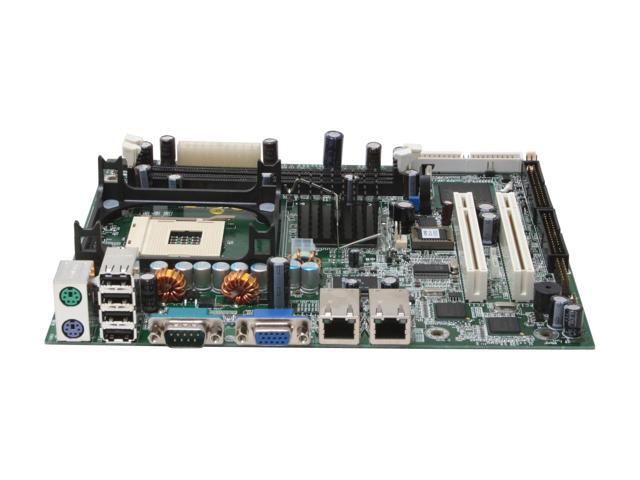
I need to build a small ASL firewall that uses little power & runs cool. I found a FlexATX board by Tyan that looks perfect. Now, I just need to decide on what CPU to get that will run the coolest. Speed doesn't matter, as any of the Pentium 4 or Celeron D's will work (I'd like to stick with at minimum the 256k L2 cache Celeron D's). Just want something cool & quiet...I'm open to other board/cpu recommendations as well!
You won't find anything capable running ASL 6 requiring less noisy (only moving part is the harddisk). The ASG 110/120 iitself is a VIA C3 Nehemia powered box containing a 2.5" harddisk that runs without making any sound at all. Power supplies for these pieces are specified for max. 60W. Haven't measured the real average power consumption, though, but I guess it should be somewhat around 15-20W.
Thanks for the info, I'm now thinking a Celeron D type setup as above isn't such a good idea due to noise/heat/power consumption
I'm now looking at the VIA EPIA PD-10000. Seem's like a very capable setup, but I've done some searching and can't find anyone running ASG/ASL 6.xxx on the PD-10000.
Any experience with this & how the PD handles Webadmin & general load?
The PD-10000 (with 512MB in my case) can handle the ASL 6.xxx for a home User, even with all Options on (both Virus Engines, IPS, Spamfilter, HTTP Proxy, ...). But if you give it a heavy Packetfilter / IPS load (Bittorrent/eDonkey) it realy slows down.
The included 4cm CPU Fan can get noisy (small Fan = high Speed = Noise) and the typical Mini-ITX Case has also only small Fans. If you want it very quiet go for a Case / Powersupply with 8cm (or bigger) Fan and also replace the CPU Fan with something bigger.
That's exactly what I'm looking for. I only have a couple active packet filters and pretty much the default IPS settings, but don't run any of the virus/smtp stuff so that should be good to go.
Do you think throwing 1GB of ram at it (vs 512MB) would help any?
I'm getting ready to order the PD-10000 & Casetronic's Travla C137-120w. Probably going to go with a 1GB of PC2100 since it's only about $30 more...besides, ASG isn't getting any smaller!
Decided to get the 120w PSU (over the 90w) as I plan to use a 1/2" 3.5" HDD & up to 2 Intel gigabit PCI NIC's (External/Internal/Wireless/DMZ). The 90w can be really taxed on bootup & heavy access with such a loaded case. With two Dual Port NIC's, you could have one hell of a gateway!
BTW, with this case, if you use a 1/2" or 3/4" tall HDD (3.5"), you can use both PCI slots using the special VIA dual slot riser. Saves on having to buy a 2.5" HDD. Luckly I had a 20GB single platter Maxtor 1/2" drive laying around from a gutted Dell.
I really don't think that 1GB is necessary, unless you are in a large business environment.
My box here at home (1.7Ghz Celeron, 384MB, 40GB) typically uses 280MB and 30MB of swap space. We download files, watch streaming media, use IPS, 30 packet rules, virus scanning, spam filtering, all the toys etc. And it still runs like a champ, no noticeable slowdowns.
I am really not sure that the PD-10000 can handle two Dualport Gigabit NIC´s on a Riser Card!!!!
A normal PCI Slot can hardly cope with a single Port Gigabit Card. And if i remember correctly there were "active" and "passive" PCI Riser Cards...
You may be better off with a Dlink DFE-580TX 4 Port 100Mbit Card (it is on the HCL, but i don´t have personal experience with it!) if you need that much Ports. If you don´t want to use the two internal NIC´s of the PD-1000 you may want to look at the newer EPIA SP-13000 (faster CPU, better Chipset, faster Memory, but only one NIC)
Thanks for the info, I just measured a dual port PCI gigabit card I've got & it should fit in the C137. It will just use one PCI slot, so hopefully it will behave better. I took a look at the SP13000 and like the more powerful CPU. If this ultimately doesn't work out as an ASL machine, it should do well as a small NAS with the 2 onboard SATA ports + IDE ports. I'm assuming the VIA C3 processor based on the C5P Nehemiah core is still compatable with ASG, since it's still in the C3 family?
Also, what about the new chipset the SP has (VIA CN400)? It looks like VIA has had open source drivers for these out since at least April of '05 for Kernel 2.6.xxx. I would assume they would have been rolled into ASG by now.
i simply don´t know if the SP13000 behaves well with Astaro... The HCL only lists the CPU Family for VIA... not one Board or specific CPU... The older VIA Cpus don´t work in ASL 6 because they did not have a complete Pentium Instruction Set (iirc)
And for the Chipset Drivers... ASL is no normal Desktop Linux Distro... They may be far behind the "bleeding edge" Chipset support...
So if there is no one on this Messageboard who has a SP13000 (and uses it for ASL) all thats left is...: Try it
I shot Astaro Support a quick e-mail specifically asking about this issue and stating I could find nothing in the HCL. What was their response? Check the HCL... [:S]
Umm, yeah...as if I didn't do that before I took time to e-mail them [;)] Also, the HCL really doesn't go into specifc working chipsets (they do list a few under the tested servers section) but mainly it's just CPU/NIC/Storage controllers.