This discussion has been locked.
You can no longer post new replies to this discussion. If you have a question you can start a new discussion

Wireless Access Point

I have a music media server which I am hooking up to my network.  It works perfect with the wired network but I am having problems with the wireless side of it.

I have a 3COM Wireless AP which I had hooked up to my previous firewall and it worked fine but cannot get it to work with ASL 5.  I have read the documentation and can only fnd the section on Wireless LAN which talks about the PCMCIA Card wireless.  I can use the 3COM Discovery application and it finds the AP and give me the IP address but when I use IE and enter the IP address I get nothing and should be getting the 3COM admin screen.

I have several NIC cards installed in my ASL box which I can use to plug in the AP point but do not know the rest oh how to configure ASL to work with the AP.  Any help or links would be appreciated as I would like to move the Squeezebox into another room and use the wireless downstairs.


Thanks in advance


This thread was automatically locked due to age.

Parents
  • The journey of a thousand miles begins with the first step.

    Can you get to the AP using CAT5 and a PC?
    What are the network settings on the PC and the AP when the firewall is out of the equation??
  • I took your advice and hooked the AP directly into another computer and I got the 3COM admin screen.  For some reason after this things started working and all of my old setting were still in the WAP.

    The WAP is recognized and is getting an IP address and the media server works all over the house, which is good. 

    Now the next question.  I currently have the WAP hooked into a switch on the internal interface.  I have read in other posts that for the highest security the WAP should be connected into another NIC card by itself like a DMZ.

    I have other NICs already in ASL5 that are available.  Should I take the WAP off of the switch and configure another interface?  If I do it this way what changes to ASL do I need to make other that adding another interface card?  I am going to take a WAG at this but should I 1)  Add another interface for the NIC card 2) add a rule to the packet filter to allow connection for the interface card.

    Also, how is the security higher for the WAP if it is connected to its own NIC as the only device as apposed to just being added to the network switch along with all of the other devices?

    Thanks in advance
  • Did you set the gateway on the Windows machine to Astaro?
  • I am not exactly sure of what you are asking.

     The only place I know of to set the gateway is in the TCP/IP settings for a NIC card when setting a static IP address.  Is this what you are talking about?  I was using DHCP on the Windows XP machines.
  • 192.168.2.120; is its gateway set to the Astaro NIC that it is connected to?
  • When I do an IPCONFIG /all on the 192.168.2.120 music server computer the following is shown:

    IP: 192.168.2.120 - 255.255.255.0
    Gateway: 192.168.2.100
    DHCP Server 192.168.2.100
    DNS -( both entries shown are valid)

    When I enable all of the items in the Ping Settings section  of ICMP I can ping 192.168.2.100 and I can ping 192.168.3.100 when pinging from the 192.168.2.120 machine.

    My default setting for the ICMP section are:
    all disabled

    Traceroute
    All disabled

    Ping Settings
    Firewall is ping visable - disabled
    Firewall forwards pings - disabled
    Ping from firewall - enabled
  • And (from 192.168.2.120) can you ping the AP, and a DHCP client of the AP?
  • No I cannot ping the AP 192.168.3.101 or the media server 192.168.3.217 from the 192.168.2.120 machine.


    Are there some other rules that need to be set in order for the 193.168.3 talk to the 192.168.2 network
  • If all the ICMP settings are enabled on Astaro, it is sounding like the AP might have some firewall of its own?

    The 192.168.2 machine can ping Astaro; you can ping the AP from Astaro; if the ICMP settings are enabled on Astaro, the ping from the 192.168.2 machine to the AP should transitively work...
  • The access point does not have a built in firewall.

     I think that a NAT/Masquerading and/or Packet filter rules needs to be created to allow 192.168.2 and 192.168.3 to talk to each other but I am not sure how to compose the rule/NAT/Masq.
  • Do you know if your AP will not accept initial incoming packets whose source is from 192.168.2? If that is the case (which would be lame), you're right. You will want a DNAT rule for a target of the AP; change source to the Astaro NIC address on 192.168.3.

    I am skeptical that is the problem, but it's easy enough to try and rule out.

  • I have a few suggestions for you.

    1. Use 192.168.20.1 for the ASL Internal network NIC, instead of 192.168.2.100. Since this NIC is the gateway for the network it serves, .1 is the appropriate address to use, not .100. Furthermore, using single digit numbers (0, 1, 2 or 3) in the third octet is not such a good idea, if you want to create VPNs to other 192.168 series private networks later on.

    2. Use 192.168.30.1 for the ASL NIC serving the DMZ interface, not 192.168.3.100. The reasons are the same as those given in item #1.

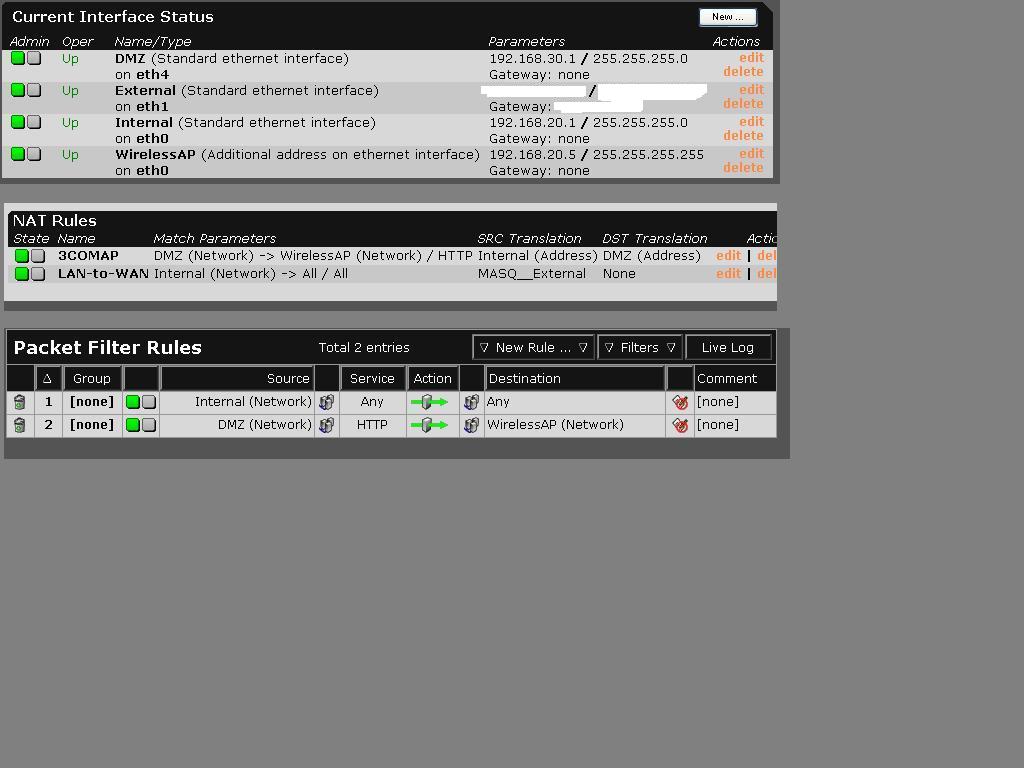
    3. Bind a secondary IP address, such as 192.168.20.5 to the Internal NIC discussed in item #1. Then set up a DNAT masquerade rule in ASL that maps your Wi-Fi access point's HTTP port across to this address. Create packet filter permissions to match. That way you will be able to access the webadmin interface of the access point, which is located on the DMZ network, by browsing to a local address on your Internal network. This approach will solve your current problem with remote administration of the Wi-Fi access point.
Reply
  • I have a few suggestions for you.

    1. Use 192.168.20.1 for the ASL Internal network NIC, instead of 192.168.2.100. Since this NIC is the gateway for the network it serves, .1 is the appropriate address to use, not .100. Furthermore, using single digit numbers (0, 1, 2 or 3) in the third octet is not such a good idea, if you want to create VPNs to other 192.168 series private networks later on.

    2. Use 192.168.30.1 for the ASL NIC serving the DMZ interface, not 192.168.3.100. The reasons are the same as those given in item #1.

    3. Bind a secondary IP address, such as 192.168.20.5 to the Internal NIC discussed in item #1. Then set up a DNAT masquerade rule in ASL that maps your Wi-Fi access point's HTTP port across to this address. Create packet filter permissions to match. That way you will be able to access the webadmin interface of the access point, which is located on the DMZ network, by browsing to a local address on your Internal network. This approach will solve your current problem with remote administration of the Wi-Fi access point.
Children
  • I have tried and have no problem changing the 192.168.3.100 interface to 192.168.30.1 but how do I change the 192.168.2.100 internal interface without hosing the system again?

    Can I just edit the internal interface and change it to 192.168.20.1 or is something else required such as reinstalling from scratch and then putting 192.168.20.1 when the install program asks for IP?

    Thanks,
  • Maybe I'm missing something?

    Of course you can change it...
  • I have taken a shot at the binding, DNAT and packet filter.  I am pretty sure that I did something wrong as I still cannot get to the files on the server computer.  I am getting a valid IP address from the AP and a connection is made.  I am using a crossover cable on the DMZ NIC to the AP.

    I think that about all that I may have gotten right is the IP binding if that.  Anyway, if you would please take a look and give me some direction on what is incorrect I would appreciate it.


    Thanks
  • Either add a seperate NIC for the wireless access point, or get rid of that additional address on the Internal interface...

    Giving it a network number that's different might also get it to work, but having such a configuration would be meaningless from a security standpoint. If you're going to seperate the networks, they have to be on separate NICs and wires...

    Or is the Internal interface dedicated for WAP use?
    If it is, just define the Class C network on the NIC and set the WAP as the NIC's gateway.

    The additional interface trick would only be used if you were constrained to supporting two sets of network addresses on one interface; but that is not the case here. We can program the WAP as we see fit; and we're going to choose a simpler network topology that reflects what you are actually doing.

    If other machines that don't go through the WAP are on the Internal network, there is no real firewalling going on between them in the configuration you lay out there.

    And by using an overlapping network number on different virtual interfaces, the routing kernel does not know which one to use (that 255.255.255.255 for the WAP Virtual interface address also exists on the Internal virtual interface). Interfaces should have mutually exclusive network numbers on Astaro (and that goes for Virtuial Interfaces too...).

  • The Access Point is on its own dedicated NIC card with an address of 192.168.30.1 and is connected straight to the ASL box NIC card using a cross over cable.

    The internal network is also on its own NIC card and is 192.168.20.1 and is connected to my internal lan.

    The external interface is connected to the WAN.

    The Access Point has two purposes.  The main one is to connect my SlimDevices media server via wireless so that the SlimDevices media server can access another computer on the 192.168.20.1 internal network to stream out my music.  The other purpose would be to allow access of my work laptop so that I can use it and the SlimDevice media server anywhere in the house.  

    If I had added an internal PCMCIA wireless card that is on the ASL hardware list would I still have these problems?

    I am getting more confused as what do do.
  • Relax!

    Why is "WirelessAP" showing on eth0, the same physical interface as "Internal"?

    Shouldn't "WirelessAP" be on its own interface, like eth3??
  • If you read the message about 5 up from VelvetFog this was to be a solution so that I could access the AP admin screen.  For some reason being on 192.168.20.1 I could not access the AP on the 192.168.30.1 network by starting IE and typing in the AP IP Address.

    This was just an additional IP address to the internal NIC per the referenced message.  The AP is on its own NIC.
  • The access point is on its own NIC card.  If you look up about 5 messages this was a fix recommended by VelvetFog on how to access the AP Admin screen.  I was having problems since the internal LAN is 192.168.20.1 and the AP is on 192.168.30.1.

    The AP is actuall hooked into the interface with a name of DMZ.
  • I don't know if that's what he meant you to do, but that configuration is not going to work.
    Delete the additional interface on Internal.

    Is the WAP hooked up to interface "DMZ"?
    What is its current IP and netmask?

    Get rid of the 3COMAP NAT rule for now.
  • Ok, I have deleted the WirelessAP interface and deleted the packet filter and DNAT rule.  All that I have now is the DMZ interface where the AP is connected to.

    The DMZ  interface is 192.168.30.1 with a netmask of 255.255.255.0

    The actual AP has a static IP of 192.168.30.10 and a netmask of 255.255.255.0